
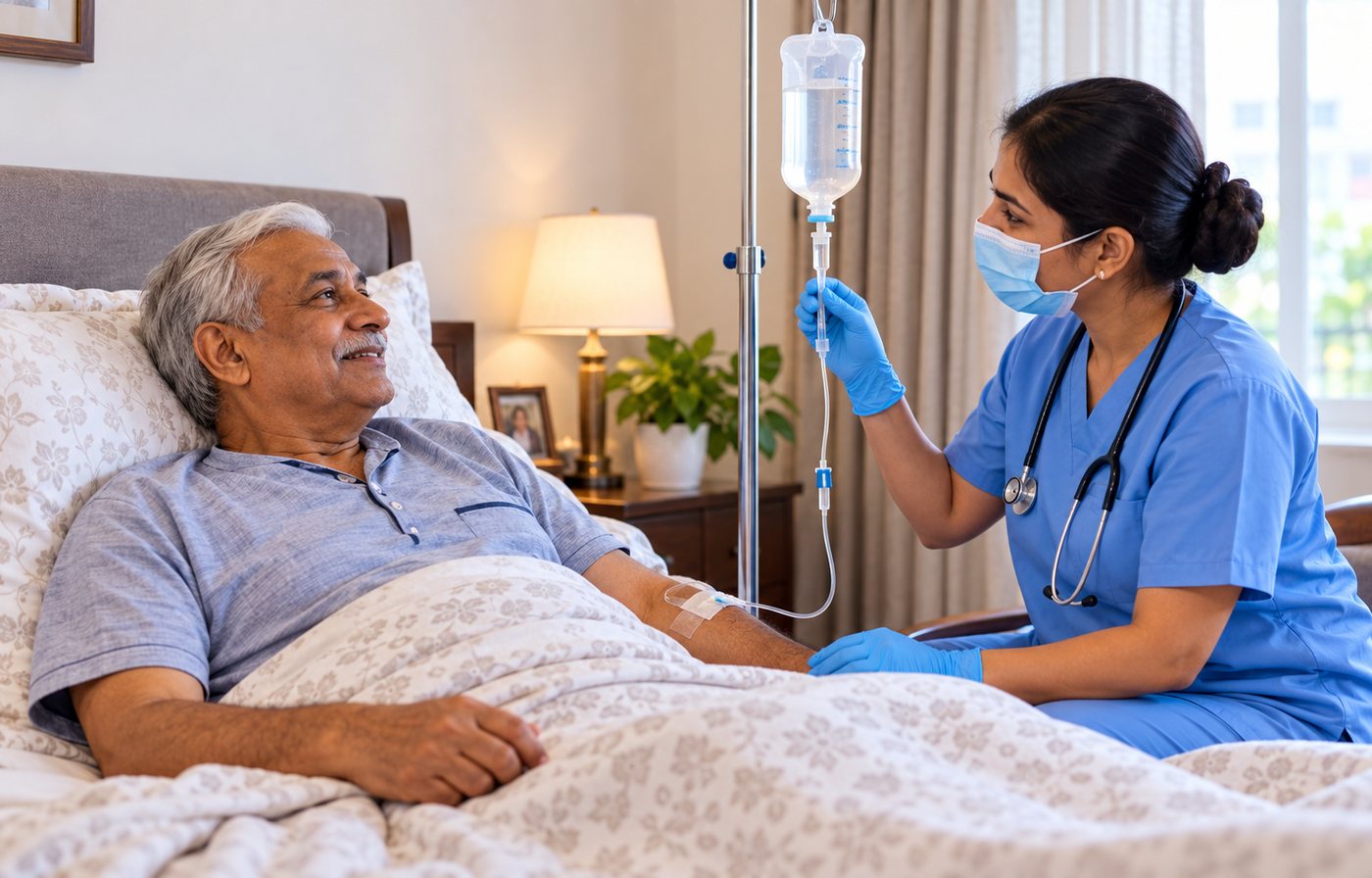
Many families ask whether a drip or IV injection can be given at home. Sometimes it can, but only when a doctor has prescribed it and the patient is stable.
Key points
- IV treatment at home needs a doctor’s prescription and a stable patient.
- Seriously ill patients, or those needing continuous monitoring, belong in hospital.
- Keep the prescription, medicines, allergy details and recent reports ready.
- Stop and call for help if there is rash, swelling, shivering or breathlessness.
When it may be possible
- A doctor has prescribed an IV antibiotic or other medicine for a set course, and the patient is stable
- Mild dehydration where a doctor has advised IV fluids
- Prescribed injections that do not need hospital monitoring
When hospital care is needed instead
- The patient is seriously ill or getting worse
- Continuous monitoring is needed
- The first dose of a medicine carries a risk of severe allergy and the doctor wants it given in hospital
- There is chest pain, severe breathlessness, heavy bleeding or loss of consciousness
What to keep ready
- The written prescription
- The medicines, bought as prescribed
- A note of any allergies and current medicines
- Recent reports
- A clean, well-lit room with a bed or chair
Safety during treatment
- A trained person places the cannula and starts the infusion
- The patient is watched during and after the first part of the dose
- Stop and call for help for rash, swelling, breathlessness, shivering or pain at the site
What we do
We give prescribed IV medicines and fluids at home when it is safe to do so, and tell you plainly when it is not. See IV injection at home and how a doctor home visit can help you decide.
Frequently asked questions
Can IV antibiotics be given at home?
Sometimes, when a doctor has prescribed a course and the patient is stable. The doctor decides if it is safe at home.
Do I need a prescription for an IV drip?
Yes. IV medicines and fluids are given only on a doctor’s prescription or advice.
How long does an IV session take?
It depends on the medicine or fluid. Some take under an hour, others several hours. Ask when you book.
Not for emergencies. Home healthcare does not replace emergency hospital care. In a medical emergency, contact emergency services or go to the nearest emergency department.